Canasta New York
Connect with Canasta enthusiasts in New York


Learn and Play Spades Gayme Night
Wed, Aug 26, 11:00 PM♠️ Queer Side Quests: Free Spades Gayme Night Happy hour from 6pm-9pm! No experience necessary! We’ll start the night by teaching everyone how to play Spades before breaking into games! Spades is a card game with deep roots in Black culture and has been bringing people together for generations. This event is open to queer folks of all ethnicities. The goal is to honor the history of the game while creating a fun, welcoming space where people can connect over a few hands of cards. RSVP to reserve your spot. Follow @queersidequests for more info and future events!


Eastside Toastmasters Meeting
Fri, Aug 28, 11:15 PM**🎃🎃 Welcome to East side Toastmasters! 🎃🎃** * **Meeting Times: Every Friday 7:15 p.m.** * **Location: 92NY (1395 Lexington Ave, 92nd street)** * **Membership Restriction: None, the club is open to all interested parties.** * **To visit our meetings in-person, please contact us at eastsidetoastmasters92@gmail.com or message us via Meetup (You are welcome to visit our meetings in-person, even if your application to this Meetup group hasn't been accepted yet).** **🌴 The East side is one of Manhattan's Toastmasters clubs holding weekly in-person meetings every Friday. This format provides a valuable chance to enhance your communication skills and expand your professional network.** **⁉️ I’d like to visit your club as a guest. Should I pay?** **💝🎁 The cost to visit a meeting as a guest is free. 💝🎁** **⁉️ How can I be a member of the East side Toastmasters** **We encourage you to attend our meetings as a guest at least three times before making a decision. When you are ready, you can find the VP Membership to fill out the form and complete your registration.** **⁉️ Do the East side members provide a warm atmosphere for guests? How many people attend the meeting usually? Does the East side have happy hour or social activities outside the Toastmasters meetings?** **When you visit the East side as a guest, other members will greet you warmly with a smile and ask your name.** **😼🐈🐈⬛ About 20 to 25 people attend every meeting. 😼🐈🐈⬛** **After the meeting, folks head over to the 🍾🍷🍷 [Barking Dog](https://barkingdognyc.com/new-york-hells-kitchen-barking-dog-locations) 🍾🦀🎉 to snack and schmooze. We have a social chair designated to take you to the Barking Dog and help you feel part of our friendship (Participation in the social round is not mandatory).** Find us also at our **[Instagram!](https://www.instagram.com/eastsidetoastmasters/)** Find our meeting photos **[here!](https://www.meetup.com/eastsidetoastmasters/photos/)**


Sunday FREE Spanish Stand Up Show | Comedia en Español en Times Square
Sun, Aug 23, 7:30 PM**[Ready to laugh your heart out in Times Square?](https://www.instagram.com/comediatimessq/)**[ ](https://www.instagram.com/comediatimessq/) Every Sunday, **Westway Diner** becomes the home of Spanish stand-up comedy in NYC — a space where Latino voices and brave newcomers take the mic and turn real life into big laughs. This isn’t just a show… it’s a weekly experience. Expect bold jokes, raw honesty, and the kind of energy only New York delivers. Whether Spanish is your first language or you just want to catch the vibe, you’ll feel part of something special. ️ **FREE entry** Drinks, community, and comedy guaranteed Times Square – Westway Diner, 614 9th Ave, New York, NY 10036 Every Sunday · Doors 3:30 PM A weekly open mic · Event is **21+** · **Drink minimum applies** Don’t just hear about it — **BE THERE**. Some of the funniest Sundays in NYC happen right here. Follow us [@ComediaTimesSQ](https://www.instagram.com/comediatimessq) **_______________________________________________________** **[¿Listo para reír a carcajadas en Times Square?](https://www.instagram.com/comediatimessq/)**[ ](https://www.instagram.com/comediatimessq/) Cada domingo, **Westway Diner** se convierte en la casa del stand-up en español en Nueva York — un espacio donde voces latinas y nuevos talentos valientes se suben al micrófono para convertir la vida real en risas. Esto no es solo un show… es una experiencia semanal. Chistes atrevidos, verdades sin filtro y la energía única de NYC. No importa si hablas español perfecto o solo vienes por la vibra: acá te vas a sentir parte de algo especial. ️ **Entrada GRATIS** Bebidas, comunidad y comedia aseguradas Times Square – Westway Diner, 614 9th Ave, New York, NY 10036 Todos los domingos · Puertas 3:30 PM Open mic semanal · Evento **21+** · **Consumo mínimo requerido** No te lo cuenten — **VÍVELO**. Algunas de las noches más graciosas de Nueva York pasan aquí. Síguenos [@ComediaTimesSQ](https://www.instagram.com/comediatimessq)


Improve Your Public Speaking Skills — Columbia University Toastmasters
Sat, Aug 22, 7:00 PM
Mejor dimelo en español=Spanish Lesson+Conversation Coffee 😎🤙🏽🌊🙂⚽️🌇
Sat, Sep 5, 2:30 PMCHANGED TO SATURDAY SEPT 5TH!! Organizer unavailable August :( 🤓☕A Spanish-only meetup! Hosted by a Native Latin American **College Spanish professor** with grammar lesson + 2 hr Spanish open conversation coffee social after 🎟️$8 via ZELLE to host EDSON (646) 704-3921 with title + date of event to join. 📲More events @ **[https://linktr.ee/nyc.connects.social](https://linktr.ee/nyc.connects.social)** * All levels of Spanish are welcome, even absolute beginners * Cafe + Pastries Social with a Spanish lesson * 1-2 cafe purchases required during event * Grammar class+exercises * limited spots available (grammar class) * Grammar class: the first 20 minutes of the event + exercises * Changes tables to meet new members. * Wonderful experience with real native Spanish/English speakers. * Newcomers who want to learn English are welcome! * Practice everything that you learned in Duolingo, institution, or college!


Park Avenue Toastmasters Club Meeting
Mon, Aug 31, 10:15 PMJoin our award-winning club and discover the joy of public speaking. Whether you're stepping in with curiosity or leaving empowered, each meeting is an opportunity to grow and have fun. Let's elevate your speaking skills together at the Wood-Ridge Memorial Library. **NOTE: Join us in Person or On-line via Zoom link below!** [https://shorturl.at/dsLU6](https://shorturl.at/dsLU6) **Where: Wood Ridge Memorial Library (Top Floor)** **231 Hackensack Street, Wood-Ridge, NJ 07075** **Time: 6:15PM, every 1st, 3rd, and 5th Monday** ***Whether you are looking to sharpen your public speaking skills, connect with a vibrant community, or simply enjoy a night of storytelling and growth, you're warmly invited to our upcoming Toastmasters meetings - held both in person and online.*** To learn more visit: [https://parkavenue.toastmastersclubs.org/](https://parkavenue.toastmastersclubs.org/)


Cuban Salsa & Rueda de Casino Classes!
Sun, Aug 23, 9:00 PM💃🏼🕺🏼Have you ever tried **Salsa**? How about ***Cuban*** **Salsa**? Now is your chance to learn this exciting & fun dance! On **Sunday, May 3rd**, we are offering a Cuban-style Salsa **BEGINNER** introduction class! The class will start its curriculum from scratch, will be in a dance studio, & will be kept comfortably small to facilitate learning, so IT DOESN’T MATTER IF YOU HAVE NEVER DANCED! Also, having a partner is not required as we constantly rotate during the class. This format gives you the opportunity to practice your steps with various partners & prepares you for the social dance scene in a safe & pressure-free environment. The teachers, a male & female, teach progressive levels of Cuban Salsa Partner work, also known as **Casino** & **Rueda de Casino** \- an interactive group dance where there are constant partner exchanges with fun patterns executed in unison\! 🇨🇺The new session of Cuban Salsa begins on **Sunday, 5/3!** 🇨🇺 ▫️**Sundays** (May 3rd - 31st): 🔹**5:00-6:00pm** \| **Absolute Beginner Cuban Salsa** - **Level 1** This class is for absolute beginners with little to no dance experience & will allow you to develop a strong foundation in Cuban Salsa in an extremely fun, stress-free atmosphere. In each 60-minute class of the four week series, students focus on developing dance fundamentals including rhythm, coordination, balance, & the specific technical aspects of Cuban Salsa, including basic steps & turn patterns, partnering technique, & the fundamental motions of Casino. Students will also learn social dancing etiquette, floorcraft, & partner safety in an extremely warm, relaxed, social & fun environment. 💲PRICE -For First Time members & their guests, **1st Class: ONLY $15, 50% OFF!!!** Normally $30 Drop-In! -Level 1 full month package of **4 classes: ONLY $75** \- Normally $100\. That's 4 classes for the price of 3\!\!\! -Payment in advance encouraged either via Credit Card: https://fuakata.square.site , Venmo: @Chris-Rogicki , Cash App: $FuakataSalsaNYC , or Zelle: Christopher.Rogicki@gmail.com **📍Location:** Adelante Studios 25 W31st Street New York, NY 10001 Between Broadway & 5th Avenue Floor 2 = Grand Ballroom Space/3,000 sq ft of Dance Floor 🗽 Herald Square/NoMad/Koreatown 🚇 **Nearby Subways:** 34th St Station on B, D, F, M, N, Q, R, & PATH trains All classes are taught by both a male, Chris/Ryan/Mark/Nick, & female, Arelys/Nayelli/Svetlana/Nikki, so women can easily follow another woman while men are following a man at the same time! They have over 26 years of training, teaching, performing, & traveling to Cuba to collaborate with the very best in the Salsa world. Feel free to contact them if you have any questions: 📨 Chris: Chris@CubanSalsaNewYork.com / 📲 908.601.3415 For those with **previous experience** dancing Cuban Salsa, we also offer a **Level 1.5/Advanced Beginner class**, also on Sundays at 5:00pm, simultaneously as the absolute beginner class. See below: ▫️**Sundays** (May 3rd - 31st) 🔹**5:00 - 6:00pm** \| **Advanced Beginner/Improver Cuban Salsa & Rueda de Casino - Level 1.5** This class is for advanced beginners that have completed our 4-week absolute beginner series & further extrapolates from key foundational motions in Cuban Salsa. In each 60-minute class of the four week series, students focus on improving & fine-tuning the core introductory elements of Casino: Exhíbela, Dile que No, Guapea, Enchufla-based patterns, closed & open position transitions, & compositional variations. Rueda de Casino, an interactive group dance involving rapid partner exchanges, will also be introduced with the goal of increasing & fortifying responsiveness in both lead & follow roles, along with spatial orientation & kinesthetic awareness. Upon completion, students will have all the necessary tools to transition to the intermediate level. 🚨 For our complete schedule & additional info, check out: 🔗 https://mailchi.mp/074abe23ff2a/cuban-salsa-new-session-begins-this-week-lets-dance We look forward to dancing with you! Con Cariño Casinero, Arelys, Evelyn, Nayelli, Nikki, Svetlana Javier, John, Mark, Nick, Ryan, Chris & the Fuákata Crew 🇨🇺 🎶 💃 💥 🕺 🎶 🇨🇺 💻 https://linktr.ee/fuakata 🔗


The Jew of Malta-Christopher Marlowe
Sun, Aug 23, 7:00 PMINVITE LINK [https://us02web.zoom.us/j/81085586371?pwd=1gR9Fao4gWGCSTNCdzfbjxnrHA1xCc.1](https://us02web.zoom.us/j/81085586371?pwd=1gR9Fao4gWGCSTNCdzfbjxnrHA1xCc.1) # *The Jew of Malta* | The Jew of Malta***The Jew of Malta*** (full title: ***The Famous Tragedy of the Rich Jew of Malta***) is a play by [Christopher Marlowe](https://en.wikipedia.org/wiki/Christopher_Marlowe "Christopher Marlowe"), written in 1589 or 1590. The plot primarily revolves around a Maltese [Jewish](https://en.wikipedia.org/wiki/Jew "Jew") merchant named [Barabas](https://en.wikipedia.org/wiki/Barabbas "Barabbas"). The original story combines religious conflict, intrigue, and revenge, set against a backdrop of the struggle for supremacy between Spain and the [Ottoman Empire](https://en.wikipedia.org/wiki/Ottoman_Empire "Ottoman Empire") in the [Mediterranean](https://en.wikipedia.org/wiki/Mediterranean "Mediterranean") that takes place on the island of [Malta](https://en.wikipedia.org/wiki/Malta "Malta"). There has been extensive debate about the play's portrayal of [Jews](https://en.wikipedia.org/wiki/Jews "Jews")and how [Elizabethan](https://en.wikipedia.org/wiki/Elizabethan_era "Elizabethan era") audiences would have viewed it. | | -------------------------------------------------------------------------------------------------------------------------------------------------------------------------------------------------------------------------------------------------------------------------------------------------------------------------------------------------------------------------------------------------------------------------------------------------------------------------------------------------------------------------------------------------------------------------------------- | | ## Characters * Machiavel, speaker of the Prologue * Barabas, a rich Jewish merchant of Malta * Abigail, his daughter * Ithamore, his slave * Ferneze, Governor of Malta * Don Lodowick, his son * Don Mathias, Lodowick's friend * Katharine, Mathias' mother * Friar Jacomo * Friar Bernardine * Abbess * Selim Calymath, son of the Emperor of Turkey * Callapine, a [bashaw](https://en.wiktionary.org/wiki/bashaw "wikt:bashaw") * Martin del Bosco, Vice Admiral of Spain * Bellamira, a [courtesan](https://en.wikipedia.org/wiki/Courtesan "Courtesan") * Pilia-Borsa, her [pimp](https://en.wikipedia.org/wiki/Pimp "Pimp") * Two merchants * Three Jews * A messenger * A slave * Knights of Malta * Officers of Malta * [Bashaws](https://en.wikipedia.org/wiki/Pasha "Pasha") serving the Turkish emperor * Carpenters * A nun * Citizens of Malta, Turkish [janizaries](https://en.wikipedia.org/wiki/Janissaries "Janissaries"), guards, attendants, slaves ## Summary [](https://en.wikipedia.org/wiki/File:Levee_du_Siege_de_Malte_by_Charles_Philippe_Lariviere_1798_1876_(cropped).jpg)*Lifting of the Siege of Malta*([Charles-Philippe Larivière](https://en.wikipedia.org/wiki/Charles-Philippe_Larivi%C3%A8re "Charles-Philippe Larivière"), c. 1842). Marlowe was inspired by the great Christian–Muslim conflict of the 1565 [Great Siege of Malta](https://en.wikipedia.org/wiki/Great_Siege_of_Malta "Great Siege of Malta").[\[1\]](https://en.wikipedia.org/wiki/The_Jew_of_Malta#cite_note-1)[\[2\]](https://en.wikipedia.org/wiki/The_Jew_of_Malta#cite_note-2) The play opens with the character Machiavel, a [Senecan](https://en.wikipedia.org/wiki/Senecan_tragedy "Senecan tragedy") ghost based on [Niccolò Machiavelli](https://en.wikipedia.org/wiki/Niccol%C3%B2_Machiavelli "Niccolò Machiavelli"), introducing "the tragedy of a Jew." Machiavel expresses the cynical view that power is amoral, saying "I count religion but a childish toy, / And hold there is no sin but ignorance."[\[3\]](https://en.wikipedia.org/wiki/The_Jew_of_Malta#cite_note-3) Barabas begins the play in his [counting-house](https://en.wikipedia.org/wiki/Counting_house "Counting house"). Stripped of all he has for protesting against the Governor of [Malta](https://en.wikipedia.org/wiki/Malta "Malta")'s seizure of the wealth of the country's whole Jewish population to pay off the warring [Turks](https://en.wikipedia.org/wiki/Ottoman_Empire "Ottoman Empire"), he develops a murderous streak by, with the help of his slave Ithamore, tricking the Governor's son and his friend into fighting over the affections of his daughter, Abigail. When they both die in a duel, he becomes further incensed when Abigail, horrified at what her father has done, runs away to become a Christian nun. In retribution, Barabas then goes on to poison her along with the whole of the [nunnery](https://en.wikipedia.org/wiki/Abbey "Abbey"), strangles an old [friar](https://en.wikipedia.org/wiki/Friar "Friar") (Barnadine) who tries to make him repent for his sins and then frames another friar (Jacomo) for the first friar's murder. After Ithamore falls in love with a prostitute who conspires with her criminal friend to blackmail and expose him (after Ithamore drunkenly tells them everything his master has done), Barabas poisons all three of them. When he is caught, he drinks "of [poppy](https://en.wikipedia.org/wiki/Poppy "Poppy") and cold [mandrake](https://en.wikipedia.org/wiki/Mandrake_(mythology) "Mandrake (mythology)") juice" so that he will be left for dead, and then plots with the enemy Turks to besiege the city. When at last Barabas is nominated governor by his new allies, he switches sides to the Christians once again. Having devised a trap for the Turks' [galley slaves](https://en.wikipedia.org/wiki/Galley_slave "Galley slave") and [soldiers](https://en.wikipedia.org/wiki/Military_of_the_Ottoman_Empire "Military of the Ottoman Empire") in which they will all be demolished by gunpowder, he then sets a trap for the Turkish prince himself and his men, hoping to boil them alive in a hidden cauldron. Just at the key moment, however, the former governor double-crosses him and causes him to fall into his own trap. The play ends with the Christian governor holding the Turkish prince hostage until reparations are paid. Barabas curses them as he burns.[\[4\]](https://en.wikipedia.org/wiki/The_Jew_of_Malta#cite_note-:3-4) ## Discussion ### Religious scepticism Despite its focus on Judaism, the play expresses scepticism of religious morality in general. Ferneze, the Christian governor of Malta, first penalises the island's Jews by seizing half of all their assets to pay tribute to the Turkish sultan, then picks on Barabas in particular when he objects, by seizing all his assets. Secondly Ferneze allows admiral Del Bosco to persuade him to break his alliance with the Turks and ally with Spain. Thirdly, at the end of the play Ferneze enthusiastically agrees with Barabas's plan to entrap and assassinate the Turks, but then betrays Barabas by triggering the trapdoor which sends him to his death. Similarly Ithamore, the Muslim slave bought by Barabas, betrays his master to Bellamira the courtesan and Pilia-Borza the thief, and blackmails him, despite Barabas having made him his heir. Thus, Christians, Jews and Muslims are all seen to act contrary to the principles of their faiths – as indeed the prologue by Machiavel hints. ### History of Elizabethan antisemitism Further information: [History of the Jews in England](https://en.wikipedia.org/wiki/History_of_the_Jews_in_England "History of the Jews in England") Jews had been officially banished from England by [King Edward I](https://en.wikipedia.org/wiki/Edward_I_of_England "Edward I of England") in 1290 with the [Edict of Expulsion](https://en.wikipedia.org/wiki/Edict_of_Expulsion "Edict of Expulsion"), nearly three hundred years before Marlowe wrote *The Jew of Malta*. They were not openly readmitted to the country [until the 1650s](https://en.wikipedia.org/wiki/Resettlement_of_the_Jews_in_England "Resettlement of the Jews in England"). Throughout the period, Jews continued to work and live in London,[\[5\]](https://en.wikipedia.org/wiki/The_Jew_of_Malta#cite_note-:2-5) and it is suggested that, while they were not fully integrated into society, they were generally tolerated and free to go about their business, within their own circles.[\[6\]](https://en.wikipedia.org/wiki/The_Jew_of_Malta#cite_note-:6-6) That said, Elizabethan audiences would generally have had little to no contact with [Jews](https://en.wikipedia.org/wiki/Jews "Jews") or [Judaism](https://en.wikipedia.org/wiki/Judaism "Judaism") in their daily life.[\[7\]](https://en.wikipedia.org/wiki/The_Jew_of_Malta#cite_note-:1-7) Lacking any actual interaction with Jews, English authors, when choosing to write Jewish characters would often resort to utilizing [antisemitic](https://en.wikipedia.org/wiki/Antisemitism "Antisemitism") tropes.[\[7\]](https://en.wikipedia.org/wiki/The_Jew_of_Malta#cite_note-:1-7)[\[8\]](https://en.wikipedia.org/wiki/The_Jew_of_Malta#cite_note-:0-8) These creations have been the subject of much debate. For instance, some argue that the lack of Jews in England created portrayals different from portrayals of Jewish characters in Europe, where they were permitted to live openly (although constantly in fear of persecution). These differences were, in turn, unique among the marginalized groups of Europe: a kind of double difference marking Jews in England as exceptionally ostracized.[\[8\]](https://en.wikipedia.org/wiki/The_Jew_of_Malta#cite_note-:0-8)[\[9\]](https://en.wikipedia.org/wiki/The_Jew_of_Malta#cite_note-9) British author [Anthony Julius](https://en.wikipedia.org/wiki/Anthony_Julius "Anthony Julius") noted that during this era, as discussion of Jews became more prominent in mainstream discourse, so did plays which contained antisemitic elements.[\[8\]](https://en.wikipedia.org/wiki/The_Jew_of_Malta#cite_note-:0-8)[\[10\]](https://en.wikipedia.org/wiki/The_Jew_of_Malta#cite_note-10) Many of the antisemitic tropes in Jewish characters written during this period were also popular among authors on [the Continent](https://en.wikipedia.org/wiki/Continental_Europe "Continental Europe"), coming about during a period of increasing contact amongst the various nations of Europe.[\[8\]](https://en.wikipedia.org/wiki/The_Jew_of_Malta#cite_note-:0-8)[\[11\]](https://en.wikipedia.org/wiki/The_Jew_of_Malta#cite_note-11) These tropes could also have contributed to the popularity of plays such as Marlowe's *The Jew of Malta*. In 1594 [Roderigo López](https://en.wikipedia.org/wiki/Roderigo_Lopez "Roderigo Lopez"), a [Converso](https://en.wikipedia.org/wiki/Converso "Converso") and doctor to [Queen Elizabeth I](https://en.wikipedia.org/wiki/Elizabeth_I_of_England "Elizabeth I of England"), was accused of attempting to poison his mistress and put on trial for treason. Public demands for his execution, many of which were loaded with antisemitic tropes, were an important factor in his conviction for [attempted murder](https://en.wikipedia.org/wiki/Attempted_murder "Attempted murder"). His execution coincided with a performance of Marlowe's play at the [Rose Theatre](https://en.wikipedia.org/wiki/The_Rose_(theatre) "The Rose (theatre)").[\[12\]](https://en.wikipedia.org/wiki/The_Jew_of_Malta#cite_note-12) ### Antisemitism in *The Jew of Malta* *The Jew of Malta*, given the time of its publication, its main character, and the significance of religion throughout the text, is often referenced in discussions about antisemitism. Some of the conversation around antisemitism in *The Jew of Malta* focuses on [authorial intent](https://en.wikipedia.org/wiki/Authorial_intent "Authorial intent"), the question of whether or not Marlowe intended to promote antisemitism in his work, while other critics focus on how the work is perceived, either by its audience at the time or by modern audiences. A [Marxist critique](https://en.wikipedia.org/wiki/Marxist_literary_criticism "Marxist literary criticism") of *The Jew of Malta* suggests that Marlowe intended to utilize readily available antisemitic feelings in his audience in a way that made the Jews "incidental" to the social critique he offered. That is, he wished to use antisemitism as a rhetorical tool rather than advocating for it. In this, Marlowe failed, instead producing a work that is, because of its failure to "discredit" the sentiments it toys with, a propagator of antisemitism. Such rhetorical attempts "underestimated the irrationality ... fixation ... and persistence of anti-Semitism".[\[7\]](https://en.wikipedia.org/wiki/The_Jew_of_Malta#cite_note-:1-7) Another viewpoint suggests that those who claim to see antisemitism in Marlowe's work often do so more because of what they think they know about the period in which they were written rather than what the texts themselves present. Thomas Cartelli, a professor of English and Film Studies at [Muhlenberg College](https://en.wikipedia.org/wiki/Muhlenberg_College "Muhlenberg College"), admits that certain of Barabas' features are troublesome vis-à-vis antisemitism, such as his large and often-referenced nose, but suggests that such surface details are not important. If one looks past the surface, it is argued, the play can be seen as uniting all three religions it represents—Judaism, Islam, and Christianity—by way of their mutual hypocrisy. These examples illustrate, though not fully, the breadth of opinions expressed on the subject.[\[13\]](https://en.wikipedia.org/wiki/The_Jew_of_Malta#cite_note-13) ### Authorship [](https://en.wikipedia.org/wiki/File:Christopher_Marlowe.jpg)[Anonymous portrait](https://en.wikipedia.org/wiki/Marlowe_portrait "Marlowe portrait"), possibly Marlowe Complicating the accusations of Marlowe's antisemitism, scholars have argued about who wrote the play. These arguments range from suggesting that the text of the play is entirely by Marlowe, but that the beginning was distorted towards the end by the strictures and deadlines of a theater's demands,[\[5\]](https://en.wikipedia.org/wiki/The_Jew_of_Malta#cite_note-:2-5) so that subsequent adaptations and manuscripts have significantly distorted the original text.[\[14\]](https://en.wikipedia.org/wiki/The_Jew_of_Malta#cite_note-14) In particular, observers believe the third, fourth and fifth acts to be written, at least partially, by someone else.[\[15\]](https://en.wikipedia.org/wiki/The_Jew_of_Malta#cite_note-15) Others disagree, pointing out that the steadily building climb of Barabas' sins, culminating with his death by his own plot, to be indicative of a consistent authorial presence.[\[16\]](https://en.wikipedia.org/wiki/The_Jew_of_Malta#cite_note-:5-16) While the play was entered in the [Stationers' Register](https://en.wikipedia.org/wiki/Stationers'_Register "Stationers' Register") on 17 May 1594, the earliest surviving edition was printed in 1633 by the bookseller Nicholas Vavasour, under the sponsorship of [Thomas Heywood](https://en.wikipedia.org/wiki/Thomas_Heywood "Thomas Heywood").[\[17\]](https://en.wikipedia.org/wiki/The_Jew_of_Malta#cite_note-17) This edition contains prologues and epilogues written by Heywood for a revival in that year. Heywood is also sometimes thought to have revised the play. Corruption and inconsistencies in the 1633 quarto, particularly in the third, fourth, and fifth acts, may be evidence of revision or alteration of the text.[\[18\]](https://en.wikipedia.org/wiki/The_Jew_of_Malta#cite_note-18) ### *The Merchant of Venice* Some critics have suggested that the play directly influenced Marlowe's contemporary, [William Shakespeare](https://en.wikipedia.org/wiki/William_Shakespeare "William Shakespeare"), in the writing of his play *[The Merchant of Venice](https://en.wikipedia.org/wiki/The_Merchant_of_Venice "The Merchant of Venice")* (written c. 1596–99).[\[19\]](https://en.wikipedia.org/wiki/The_Jew_of_Malta#cite_note-:4-19) James Shapiro notes that both *The Merchant of Venice* and *The Jew of Malta* are works obsessed with the economics of their day, stemming from anxiety around new business practices in the theater, including the bonding of actors to companies. Such bonds would require actors to pay a hefty fee if they performed with other troupes or were otherwise unable to perform. In this way, greed becomes an allegory rather than a characteristic or stereotype.[\[19\]](https://en.wikipedia.org/wiki/The_Jew_of_Malta#cite_note-:4-19) Others believe that the suggestion of imitation by Shakespeare of Marlowe is overblown, and that not only the two stories are very different, but the principal characters that are often compared, Shylock and Barabas, are themselves profoundly different.[\[6\]](https://en.wikipedia.org/wiki/The_Jew_of_Malta#cite_note-:6-6) While critics debate whether or not *The Jew of Malta* was a direct influence, or merely a product of the contemporaneous society that they both were written in, it is noteworthy that Marlowe and Shakespeare were the only two English playwrights of their time to include a Jewish principal character in one of their plays.[\[6\]](https://en.wikipedia.org/wiki/The_Jew_of_Malta#cite_note-:6-6) ### Biblical punishment At the end of the play, Barabas attempts to murder his erstwhile Turkish allies by tricking them into falling through a trap door into a hot cauldron in a pit. In the end, it is Barabas who falls into his own fiery pit and dies a violent death.[\[4\]](https://en.wikipedia.org/wiki/The_Jew_of_Malta#cite_note-:3-4) The method by which Barabas dies has several specific Biblical overtones, and these connections have been acknowledged by scholars.[\[16\]](https://en.wikipedia.org/wiki/The_Jew_of_Malta#cite_note-:5-16) In terms of the specifications for punishment dictated by the [Old Testament](https://en.wikipedia.org/wiki/Old_Testament "Old Testament"), it matches the crime in Barabas' case: he is guilty of murder, fraud, and [betraying fellow Jews](https://en.wikipedia.org/wiki/Mesirah "Mesirah").[\[16\]](https://en.wikipedia.org/wiki/The_Jew_of_Malta#cite_note-:5-16) Secondarily, there is a frequent use in Judaism of a device where a perpetrator is ensnared in his own trap. An example of this includes [Haman](https://en.wikipedia.org/wiki/Haman "Haman"), in the story of [Purim](https://en.wikipedia.org/wiki/Purim "Purim"), being hanged on the very gallows he intended for the Jews he wished to murder.[\[16\]](https://en.wikipedia.org/wiki/The_Jew_of_Malta#cite_note-:5-16) ## Performance and reception *The Jew of Malta* was an immediate success[\[5\]](https://en.wikipedia.org/wiki/The_Jew_of_Malta#cite_note-:2-5) from its first recorded performance at the [Rose Theatre](https://en.wikipedia.org/wiki/The_Rose_(theatre) "The Rose (theatre)") in early 1592, when [Edward Alleyn](https://en.wikipedia.org/wiki/Edward_Alleyn "Edward Alleyn") played the lead role.[\[20\]](https://en.wikipedia.org/wiki/The_Jew_of_Malta#cite_note-20) The play was subsequently presented by Alleyn's [Lord Strange's Men](https://en.wikipedia.org/wiki/Lord_Strange's_Men "Lord Strange's Men") seventeen times between 26 February 1592 and 1 February 1593. It was performed by [Sussex's Men](https://en.wikipedia.org/wiki/Sussex's_Men "Sussex's Men") on 4 February 1594, and by a combination of Sussex's and [Queen Elizabeth's Men](https://en.wikipedia.org/wiki/Queen_Elizabeth's_Men "Queen Elizabeth's Men") on 3 and 8 April 1594. More than a dozen performances by the [Admiral's Men](https://en.wikipedia.org/wiki/Admiral's_Men "Admiral's Men") occurred between May 1594 and June 1596. (The play apparently belonged to impresario [Philip Henslowe](https://en.wikipedia.org/wiki/Philip_Henslowe "Philip Henslowe"), since the cited performances occurred when the companies mentioned were acting for Henslowe.) In 1601 Henslowe's diary notes payments to the Admiral's company for props for a revival of the play.[\[21\]](https://en.wikipedia.org/wiki/The_Jew_of_Malta#cite_note-21) The play remained popular for the next fifty years, until [England's theaters](https://en.wikipedia.org/wiki/English_Renaissance_theatre "English Renaissance theatre") were closed in 1642. In the [Caroline era](https://en.wikipedia.org/wiki/Caroline_era "Caroline era"), actor Richard Perkins was noted for his performances as Barabas when the play was revived in 1633 by [Queen Henrietta's Men](https://en.wikipedia.org/wiki/Queen_Henrietta's_Men "Queen Henrietta's Men"). The title page of the 1633 quarto refers to this revival, performed at the [Cockpit Theatre](https://en.wikipedia.org/wiki/Cockpit_Theatre "Cockpit Theatre").[\[22\]](https://en.wikipedia.org/wiki/The_Jew_of_Malta#cite_note-22) The play was revived by [Edmund Kean](https://en.wikipedia.org/wiki/Edmund_Kean "Edmund Kean") at [Drury Lane](https://en.wikipedia.org/wiki/Drury_Lane "Drury Lane") on 24 April 1818. The script of this performance included additions by S. Penley.[\[23\]](https://en.wikipedia.org/wiki/The_Jew_of_Malta#cite_note-23) It was considered a successful production at the time. However, in an anonymous biography of Kean published seventeen years later, it suggests that the success of the production came from Kean's performance and his addition of a song to the role of Barabas, and that the play itself, on its own, was a failure.[\[5\]](https://en.wikipedia.org/wiki/The_Jew_of_Malta#cite_note-:2-5) The [Royal Shakespeare Company](https://en.wikipedia.org/wiki/Royal_Shakespeare_Company "Royal Shakespeare Company") staged a new production at the [Barbican](https://en.wikipedia.org/wiki/Barbican "Barbican") in 1988, with [Alun Armstrong](https://en.wikipedia.org/wiki/Alun_Armstrong "Alun Armstrong") as Barnabas. On 2 October 1993, [Ian McDiarmid](https://en.wikipedia.org/wiki/Ian_McDiarmid "Ian McDiarmid") starred as Barabas in a [BBC Radio 3](https://en.wikipedia.org/wiki/BBC_Radio_3 "BBC Radio 3") adaptation of the play directed by Michael Fox, with [Ken Bones](https://en.wikipedia.org/wiki/Ken_Bones "Ken Bones") as Machevil and Ferneze, [Kathryn Hunt](https://en.wikipedia.org/wiki/Kathryn_Hunt "Kathryn Hunt") as Abigail, [Michael Grandage](https://en.wikipedia.org/wiki/Michael_Grandage "Michael Grandage") as Don Lodowick, [Neal Swettenham](https://en.wikipedia.org/wiki/Neal_Swettenham?action=edit&redlink=1 "Neal Swettenham (page does not exist)") as Don Mathias and [Kieran Cunningham](https://en.wikipedia.org/wiki/Kieran_Cunningham?action=edit&redlink=1 "Kieran Cunningham (page does not exist)") as Ithamore.[\[24\]](https://en.wikipedia.org/wiki/The_Jew_of_Malta#cite_note-24) # The Jew of Malta – antisemitic or a satire on antisemitism? Wolf Hall meets Quentin Tarantino – religious tensions and racial violence play out in the RSC’s impeccably timed revival of Marlowe’s The Jew of Malta [Charles Nicholl](https://www.theguardian.com/profile/charles-nicholl) Fri 27 Mar 2015 Christopher Marlowe’s controversial career was abruptly curtailed when he was stabbed to death at the age of 29. His reputation as the greatest of the pre-Shakespearean dramatists rests on just seven plays written in the late 1580s and early 1590s. The best known of these is *[Doctor Faustus](http://bookshop.theguardian.com/doctor-faustus-9.html)*, a thunderous study of magic and damnation. But perhaps the bleakest and most challenging of his works is *[The Jew of Malta](http://bookshop.theguardian.com/jew-of-malta-263203.html)*, now at the Swan theatre in Stratford in a new production by the Royal Shakespeare Company directed by Justin Audibert. The timing of this revival is almost uncanny. While *Doctor Faustus* scared its early audiences with visions of hellfire, *The Jew of Malta* seems tailor-made for more topical fears. Its chief theme is antisemitism. It is a story of religious tensions and racist violence, of tangled motives and shifting sympathies, played out against the backdrop of a cynical society whose true creed is neither religion nor ideology but grasping materialist greed. A searchable online text reveals the play’s keywords to be “gold”, which occurs 38 times, followed by “death” (25), “villain” and “villainy” (24), “money” (23), “poison” (18), “slave” (16) and “policy” (13) – the last in its Elizabethan sense of cunning machiavellian stratagems. The presentation of the eponymous Jew, Barabas, veers between victim, anti-hero and monster. Brutalised – or as we now say “radicalised” – by ill treatment, he goes on a spree of cold-blooded killings. His victims are mostly Christians, but they also include his own daughter Abigail, who has fled to a nunnery, and a troop of Turkish soldiers burned alive in their garrison. He sums up his code of conduct, or survival, thus: > First, be thou void of these affections: > > Compassion, love, vain hope, and heartless fear; > Be moved at nothing; see thou pity none. All this might suggest an uncomfortable evening in store, but with Marlowe such expectations are there to be upended, and this toxic cocktail of alienation and murder is laced throughout with deadpan black comedy. Think *[Wolf Hall](http://bookshop.theguardian.com/wolf-hall-2.html)* reimagined by [Quentin Tarantino](https://www.theguardian.com/film/quentintarantino), and you begin to get the feel of it. The title page of the first extant edition (1633) describes the play as a tragedy, but as [TS Eliot](https://www.theguardian.com/books/ts-eliot) observed nearly a century ago, it becomes more “intelligible” if one takes it “not as a tragedy … but as a farce”, written in a tone of “serious, even savage comic humour”. Eliot also enjoyed the equivocating shrug of Barabas’s response to a charge of fornication – “But that was in another country, / And besides the wench is dead” – and took it for the epigraph for his poem [“Portrait of a Lady”](http://www.poetryfoundation.org/poem/173477). 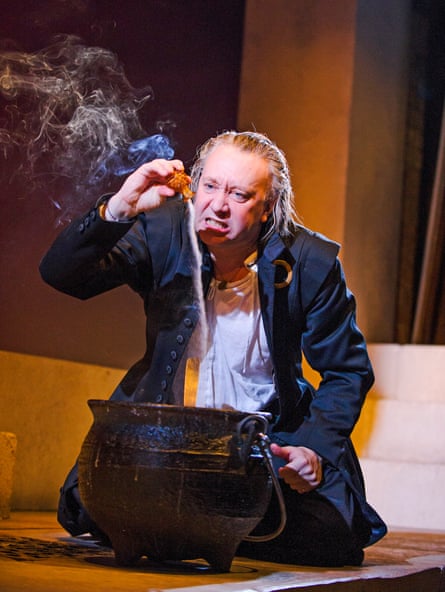[View image in fullscreen](https://www.theguardian.com/stage/2015/mar/27/the-jew-of-malta-christopher-marlowe-stage-rsc-swan-theatre#img-2) Jasper Britton (Barabas) in the RSC’s *The Jew Of Malta*.Photograph: Tristram Kenton for the Guardian The play is sometimes dated to around 1589, as it mentions the death of the Duke of Guise (December 1588), but the chronology of Marlowe’s plays is largely guesswork. The first record of it on stage was on 26 February 1592, when it was performed by Lord Strange’s Men at the Rose theatre in Southwark, with Edward Alleyn in the title role. It was the Rose’s top-earning play of the 1592-93 season, in a repertory that included such crowd-pleasers as [Thomas Kyd’s ](http://bookshop.theguardian.com/spanish-tragedy-3.html)*[Spanish Tragedy](http://bookshop.theguardian.com/spanish-tragedy-3.html)* and [Shakespeare’s ](http://bookshop.theguardian.com/henry-iv-part-one.html)*[Henry VI Part 1](http://bookshop.theguardian.com/henry-iv-part-one.html)*. A line in the latter – “My heart, sweet boy, shall be thy sepulchre” – sounds like an echo of Barabas’s “These arms of mine shall be thy sepulchre”. This foreshadows the more extensive reverberations of Marlowe’s play in Shakespeare’s presentation of Shylock in *[The Merchant of Venice](http://bookshop.theguardian.com/the-merchant-of-venice.html)*. A successful later run at the Rose in 1594 can be related to the high-profile arraignment of the Queen’s physician, Rodrigo López. A Portuguese Jew, López was charged in February 1594 with conspiring to poison the Queen, and was executed with the usual barbarities in June. His trial, in the absence of hard evidence, featured a good deal of anti-Jewish propaganda, and it cannot be doubted that the concurrent revival of the play cashed in on the public mood arising from this. Marlowe was dead by this point (and anyway the playscript belonged to the Rose’s owner Philip Henslowe), so it was not he who cashed in on it. *The Jew of Malta* is certainly a play about antisemitism, but is it also (as is often thought) an antisemitic play? It is true that Barabas is given the stock negative attributes of the Jew – rapacious and avaricious, a usurer who has “filled the gaols with bankrupts”, a hater of Christians – and that his name, echoing the Barabbas of the Gospels, alludes to the view that Jews were responsible for Christ’s crucifixion. It may also be true that Barabas was played wearing a large false nose, since a minor Jacobean comedy, *The Search for Money* by William Rowley, describes a usurer as wearing a “visage like the artificial Jew of Malta’s nose”: this is a late reference (c1609) so it may not describe the original production, though one notes that Marlowe’s text refers to Barabas as a “bottle-nosed knave”. But Marlowe’s purpose in presenting us with this pantomime Jew is surely to satirise the crudity of the stereotype. It is a provocative or Hebdoesque piece of religious cartooning that challenges the complacencies and credulities of his audience. The outlandish elements of the portrait – “that Jew: he lives upon pickled grasshoppers and sauced mushrumps … He never put on clean shirt since he was circumcised …The hat he wears, Judas left under the elder when he hanged himself”, etc – are a *reductio ad absurdum* of antisemitic attitudes. It must be remembered that Jews were comparatively rare in Elizabethan England – they had been “expelled” three centuries earlier – so the populist fear of them that the play taps into was essentially folkloric. Contemporary accounts of Marlowe paint him as a trenchant critic of religious superstition – one who “perswades men … not to be afeard of bugbeares and hobgoblins” – and it seems unlikely he actually held the views that are voiced onstage (any more than he actually believed that the scholar Faustus deserved eternal damnation for his extracurricular studies in the occult). I offer this reading of the play as a corrective argument rather than a deeply held conviction – the latter is anyway a currency Marlowe valued very little. 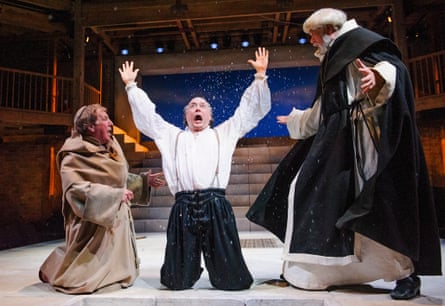[View image in fullscreen](https://www.theguardian.com/stage/2015/mar/27/the-jew-of-malta-christopher-marlowe-stage-rsc-swan-theatre#img-3) Geoffrey Freshwater (Friar Barnadine), Jasper Britton (Barabas) and Matthew Kelly (Friar Jacomo) in the RSC’s *The Jew Of Malta*. Photograph: Tristram Kenton for the Guardian Though Barabas bestrides the stage like a problematic colossus, there is a sense in which the presiding figure of the play is the one brought on at the beginning to deliver its 35-line prologue. The first words of the playscript are a stage direction: “Enter Machevill”. Here too we have a provocative stereotype, for “Machevill” (or “make-evil”) is of course a punning pronunciation of Machiavelli. The Florentine political philosopher Niccolò Machiavelli had died more than 50 years previously, but in England he remained a kind of bogeyman, deplored by the orthodox as one who divested political action of morality. He was essentially a banned author – none of his political texts had appeared in English. There were editions in Italian and Latin, and there were translations in manuscript, but no publisher had dared to print them. Another half-century would pass before Edward Dacre’s translations were printed: the *Discourses* in 1636, and that handbook of stark realpolitik, *[The Prince](https://www.theguardian.com/books/2009/jun/27/prince-niccolo-machiavelli-tim-parks)*, in 1640. Marlowe’s machiavellian prologue is the coup de theatre of 1592, trailing these dangerous ideas – “I count religion but a childish toy / And hold there is no sin but ignorance” – and fixing the play’s dominant critique. When Barabas briefly becomes governor of Malta he muses in machiavellian vein on the need to profit from his power: > For he that liveth in authority, > > And neither gets him friends nor fills his bags, > Lives like the ass that Aesop speaketh of, > That labours with a load of bread and wine, > And leaves it off to snap on thistle tops. These lines typify the toughness and stripped-down clarity of Marlowe’s versification, and they convey the play’s central message that the demon Barabas is in essence no different from the Christian governor, Fernese, who has been busily following the same amoral code of power, violence and profit under a cloak of religious hypocrisy – “Ay policy! That’s their profession, / And not simplicity as they suggest.” Marlowe was himself no stranger to the tawdry world of political intrigue that is the milieu of the play, nor indeed to the dangers of being demonised. In the spring of 1593 he was incriminated by informers as a heretic and blasphemer: the presentation of him in such documents as the infamous “Baines Note” might well be described as the “pantomime atheist”. On 20 May he was brought before the privy council for questioning; 10 days later he was fatally stabbed through the right eye in a Deptford lodging-house – a dissident author (in one reading of this sequence of events) disappearing in a huddle of snoops and spies, those “climbing followers”, to borrow an ominous phrase from *The Jew of Malta*, who sought advancement in the downfall of others. *[The Jew of Malta](http://www.rsc.org.uk/whats-on/the-jew-of-malta/)*[ is at the RSC Swan](http://www.rsc.org.uk/whats-on/the-jew-of-malta/), Stratford-Upon-Avon, until 8 September. Charles Nicholl’s *[The Reckoning: The Murder of Christopher Marlowe](http://bookshop.theguardian.com/reckoning-15.html)* is published by Vintage.


Tuesday Cavendish Bridge & Backgammon Club
Tue, Sep 1, 11:00 PMJoin us for a Chouette or Match Night of Backgammon. 3 - 4 Player chouette game. Opening at 7:00pm & Chouette play start at 7:30pm. **RSVP** to be included in a 2 hour Chouette or 7 Point Matches. 1st & 2nd Place Prizes The Chouette's Last Game is 9:30pm - so it is a timed event On Tuesdays at Backgammon New York City BGNYC we are back to serving light snacks, wine, beer, tea, and coffee. Backgammon Sign-in & Boards on the 12th floor. We will close around 11:00 pm. Please bring your board if you have one (if you don't, we have a limited amount on hand). We also have a sister website https://www.meetup.com/manhattan-games-center/. We look forward to seeing you. Send Email to BGNYCusa@gmail.com for Any Questions. John B


Argentine Tango Class & Party - Domingo Loco
Sun, Aug 23, 9:00 PMMilonga Domingo Loco (Every 4th Sunday of the month) at El Barrio’s Artspace PS109, 215 E 99th Street, NYC Green & Yellow Subways One Block away Free Parking on Streets and Avenues Beautiful large Dance Floor (Real Wood) Outdoor Space with benches available for chilling out Tango Lesson from 5-6 p.m. with Guest Teachers Performance around 8 p.m. Milonga from 6-10 p.m. $25 Hosts: Dragan Ranitovic & Elliott Ortiz... Photography & Technical Support: Marc Fiaux Cash Food & Drinks Available


Summer Noche Cubana @ Hotel Alameda
Sun, Aug 23, 12:00 AM🇨🇺 Special Edition 🏝️ Summer Noche Cubana 🎉 ✨ Join us for a special summer edition of Noche Cubana as we celebrate warm weather, friendship, great music, & unforgettable dancing in the heart of Chelsea. 🌃 Whether you’re a longtime Casinero, a Son lover, a Timba addict, or stepping onto the dance floor for the very first time, everyone is welcome! 🗓️ Saturday, August 22nd 🕰️ 8:00pm – 12:00am 📍Hotel Alameda 518 W 27th Street Chelsea / High Line — NYC 💛 Dress Code: Summer Colors Only! 🌺 Think tropical prints, linens, florals, bright colors! What to Expect: ▫️ 8:00pm – Cuban Dance Lesson 👣 + Dinner 🍽️ & Drinks 🍸 ▫️ 8:30pm – Party Begins 🎉 ▫️ Till Midnight – Timba y Lo Mejor de La Música Cubana 🎶 ✨ Huge Dance Floor ✨ Great Vibes 🎟️ Cover: $15 Early Bird $20 Week of Event $25 on August 22nd ⤵️ Payment Options • Cash 💵 • Venmo: Chris-Rogicki (3415) • CashApp: $FuakataSalsaNYC • Zelle: Christopher.Rogicki@gmail.com • 💳 Credit Card: [https://fuakata.square.site/product/noche-cubana-hotel-alameda-at-the-high-line/47](https://fuakata.square.site/product/noche-cubana-hotel-alameda-at-the-high-line/47) 🚇 Subways: E, C ☀️ Grab your friends, bring your dancing shoes, & kick off the summer season with NYC’s Cuban dance community. Con Cariño Casinero, Arelys, Evelyn, Nayelli, Nikki, Svetlana, Javier, John, Mark, Nick, Ryan, Chris & the Fuákata Crew 🇨🇺 [#NocheCubana](https://www.facebook.com/hashtag/nochecubana?__cft__%5B0%5D=AZbKLbAJ3noc6PiHxQi-yBj9zzMiHmW8gNolB9KW91v8jGu97VheuSTX_toYxUjYBXBA0w3ATy4NoEP1bWq7lEmwZwGvmy18KLxL6ou4q0N_ULXf825LHbQPmMXS0qIKkkZpKmbP4aVE_e71Ysce-Ddo&__tn__=q) [#timbanyc](https://www.facebook.com/hashtag/timbanyc?__cft__%5B0%5D=AZbKLbAJ3noc6PiHxQi-yBj9zzMiHmW8gNolB9KW91v8jGu97VheuSTX_toYxUjYBXBA0w3ATy4NoEP1bWq7lEmwZwGvmy18KLxL6ou4q0N_ULXf825LHbQPmMXS0qIKkkZpKmbP4aVE_e71Ysce-Ddo&__tn__=q) [#fuákatacubansalsany](https://www.facebook.com/hashtag/fu%C3%A1katacubansalsany?__cft__%5B0%5D=AZbKLbAJ3noc6PiHxQi-yBj9zzMiHmW8gNolB9KW91v8jGu97VheuSTX_toYxUjYBXBA0w3ATy4NoEP1bWq7lEmwZwGvmy18KLxL6ou4q0N_ULXf825LHbQPmMXS0qIKkkZpKmbP4aVE_e71Ysce-Ddo&__tn__=q) [#fuakatasocial](https://www.facebook.com/hashtag/fuakatasocial?__cft__%5B0%5D=AZbKLbAJ3noc6PiHxQi-yBj9zzMiHmW8gNolB9KW91v8jGu97VheuSTX_toYxUjYBXBA0w3ATy4NoEP1bWq7lEmwZwGvmy18KLxL6ou4q0N_ULXf825LHbQPmMXS0qIKkkZpKmbP4aVE_e71Ysce-Ddo&__tn__=q) [#ruedadecasino](https://www.facebook.com/hashtag/ruedadecasino?__cft__%5B0%5D=AZbKLbAJ3noc6PiHxQi-yBj9zzMiHmW8gNolB9KW91v8jGu97VheuSTX_toYxUjYBXBA0w3ATy4NoEP1bWq7lEmwZwGvmy18KLxL6ou4q0N_ULXf825LHbQPmMXS0qIKkkZpKmbP4aVE_e71Ysce-Ddo&__tn__=q)

Play & Date (*Dating Games. New Twist on Speed Dating Event)
Sun, Aug 30, 12:00 AMLearn and Play Spades Gayme Night
Wed, Aug 26, 11:00 PM♠️ Queer Side Quests: Free Spades Gayme Night Happy hour from 6pm-9pm! No experience necessary! We’ll start the night by teaching everyone how to play Spades before breaking into games! Spades is a card game with deep roots in Black culture and has been bringing people together for generations. This event is open to queer folks of all ethnicities. The goal is to honor the history of the game while creating a fun, welcoming space where people can connect over a few hands of cards. RSVP to reserve your spot. Follow @queersidequests for more info and future events!
Eastside Toastmasters Meeting
Fri, Aug 28, 11:15 PM**🎃🎃 Welcome to East side Toastmasters! 🎃🎃** * **Meeting Times: Every Friday 7:15 p.m.** * **Location: 92NY (1395 Lexington Ave, 92nd street)** * **Membership Restriction: None, the club is open to all interested parties.** * **To visit our meetings in-person, please contact us at eastsidetoastmasters92@gmail.com or message us via Meetup (You are welcome to visit our meetings in-person, even if your application to this Meetup group hasn't been accepted yet).** **🌴 The East side is one of Manhattan's Toastmasters clubs holding weekly in-person meetings every Friday. This format provides a valuable chance to enhance your communication skills and expand your professional network.** **⁉️ I’d like to visit your club as a guest. Should I pay?** **💝🎁 The cost to visit a meeting as a guest is free. 💝🎁** **⁉️ How can I be a member of the East side Toastmasters** **We encourage you to attend our meetings as a guest at least three times before making a decision. When you are ready, you can find the VP Membership to fill out the form and complete your registration.** **⁉️ Do the East side members provide a warm atmosphere for guests? How many people attend the meeting usually? Does the East side have happy hour or social activities outside the Toastmasters meetings?** **When you visit the East side as a guest, other members will greet you warmly with a smile and ask your name.** **😼🐈🐈⬛ About 20 to 25 people attend every meeting. 😼🐈🐈⬛** **After the meeting, folks head over to the 🍾🍷🍷 [Barking Dog](https://barkingdognyc.com/new-york-hells-kitchen-barking-dog-locations) 🍾🦀🎉 to snack and schmooze. We have a social chair designated to take you to the Barking Dog and help you feel part of our friendship (Participation in the social round is not mandatory).** Find us also at our **[Instagram!](https://www.instagram.com/eastsidetoastmasters/)** Find our meeting photos **[here!](https://www.meetup.com/eastsidetoastmasters/photos/)**
Sunday FREE Spanish Stand Up Show | Comedia en Español en Times Square
Sun, Aug 23, 7:30 PM**[Ready to laugh your heart out in Times Square?](https://www.instagram.com/comediatimessq/)**[ ](https://www.instagram.com/comediatimessq/) Every Sunday, **Westway Diner** becomes the home of Spanish stand-up comedy in NYC — a space where Latino voices and brave newcomers take the mic and turn real life into big laughs. This isn’t just a show… it’s a weekly experience. Expect bold jokes, raw honesty, and the kind of energy only New York delivers. Whether Spanish is your first language or you just want to catch the vibe, you’ll feel part of something special. ️ **FREE entry** Drinks, community, and comedy guaranteed Times Square – Westway Diner, 614 9th Ave, New York, NY 10036 Every Sunday · Doors 3:30 PM A weekly open mic · Event is **21+** · **Drink minimum applies** Don’t just hear about it — **BE THERE**. Some of the funniest Sundays in NYC happen right here. Follow us [@ComediaTimesSQ](https://www.instagram.com/comediatimessq) **_______________________________________________________** **[¿Listo para reír a carcajadas en Times Square?](https://www.instagram.com/comediatimessq/)**[ ](https://www.instagram.com/comediatimessq/) Cada domingo, **Westway Diner** se convierte en la casa del stand-up en español en Nueva York — un espacio donde voces latinas y nuevos talentos valientes se suben al micrófono para convertir la vida real en risas. Esto no es solo un show… es una experiencia semanal. Chistes atrevidos, verdades sin filtro y la energía única de NYC. No importa si hablas español perfecto o solo vienes por la vibra: acá te vas a sentir parte de algo especial. ️ **Entrada GRATIS** Bebidas, comunidad y comedia aseguradas Times Square – Westway Diner, 614 9th Ave, New York, NY 10036 Todos los domingos · Puertas 3:30 PM Open mic semanal · Evento **21+** · **Consumo mínimo requerido** No te lo cuenten — **VÍVELO**. Algunas de las noches más graciosas de Nueva York pasan aquí. Síguenos [@ComediaTimesSQ](https://www.instagram.com/comediatimessq)
Improve Your Public Speaking Skills — Columbia University Toastmasters
Sat, Aug 22, 7:00 PMMejor dimelo en español=Spanish Lesson+Conversation Coffee 😎🤙🏽🌊🙂⚽️🌇
Sat, Sep 5, 2:30 PMCHANGED TO SATURDAY SEPT 5TH!! Organizer unavailable August :( 🤓☕A Spanish-only meetup! Hosted by a Native Latin American **College Spanish professor** with grammar lesson + 2 hr Spanish open conversation coffee social after 🎟️$8 via ZELLE to host EDSON (646) 704-3921 with title + date of event to join. 📲More events @ **[https://linktr.ee/nyc.connects.social](https://linktr.ee/nyc.connects.social)** * All levels of Spanish are welcome, even absolute beginners * Cafe + Pastries Social with a Spanish lesson * 1-2 cafe purchases required during event * Grammar class+exercises * limited spots available (grammar class) * Grammar class: the first 20 minutes of the event + exercises * Changes tables to meet new members. * Wonderful experience with real native Spanish/English speakers. * Newcomers who want to learn English are welcome! * Practice everything that you learned in Duolingo, institution, or college!
Park Avenue Toastmasters Club Meeting
Mon, Aug 31, 10:15 PMJoin our award-winning club and discover the joy of public speaking. Whether you're stepping in with curiosity or leaving empowered, each meeting is an opportunity to grow and have fun. Let's elevate your speaking skills together at the Wood-Ridge Memorial Library. **NOTE: Join us in Person or On-line via Zoom link below!** [https://shorturl.at/dsLU6](https://shorturl.at/dsLU6) **Where: Wood Ridge Memorial Library (Top Floor)** **231 Hackensack Street, Wood-Ridge, NJ 07075** **Time: 6:15PM, every 1st, 3rd, and 5th Monday** ***Whether you are looking to sharpen your public speaking skills, connect with a vibrant community, or simply enjoy a night of storytelling and growth, you're warmly invited to our upcoming Toastmasters meetings - held both in person and online.*** To learn more visit: [https://parkavenue.toastmastersclubs.org/](https://parkavenue.toastmastersclubs.org/)
Trusted by millions worldwide


Popular groups

Clásico de Clásicos (Musica y Bailes de Todos los Tiempos )


New York and NJ Spades Meetup Group


Aperitono!


Stand Up en Español


Backgammon New York City - BGNYC


Salsa, Merengue, Bachata, Kizomba Dancers Meetup Group


ACMA (The Association of Classical Musicians and Artists)


Salsa & Latin Dance NYC Meetup Group


Frequently asked questions
Meetup is a platform for finding and joining local groups and attending events based on shared interests, both online and in-person.
Joining a Canasta group in New York offers the chance to meet fellow enthusiasts, enjoy social games, and sharpen your skills with like-minded individuals.
To find Canasta events in New York, simply search for Canasta-related groups on Meetup. You'll see a list of upcoming gatherings in your area to join.
Yes, you can join multiple Canasta groups. Each group may offer different events and experiences, providing variety in your gaming life.
Having basic knowledge helps, but many groups welcome beginners and might offer introductory sessions to teach you the game.
They can be both! Check each event's details to know if it's happening online or at a local venue in New York.
Once you join a group, you can RSVP to events via the Meetup platform, ensuring a spot in the upcoming Canasta meeting.
No, attendance is flexible. You're welcome to join events that suit your schedule and interest without committing to all meetups.
Many Canasta meetups are free, but some might have a nominal fee, especially if a venue or materials are involved. Check event details for specifics.
Meetup connects you to groups based on your interests, facilitating gatherings where you can engage and form friendships with fellow members.
Event quality can vary. It's organized by group hosts, so experience may differ. Check reviews and ratings for insights into event quality.
Availability depends on existing groups in the area. If a specific Canasta group doesn't exist, you could consider starting your own!.
Meetup is mostly for group activities, focusing more on social gatherings rather than individual matches.
Success varies based on active participation and individual preferences. Many users find them rewarding and enjoyable.
While Meetup hosts a variety of interests, the presence of a specific Canasta group in New York depends on current organizer activity.
Related content
Discover more groups and events that match your interests